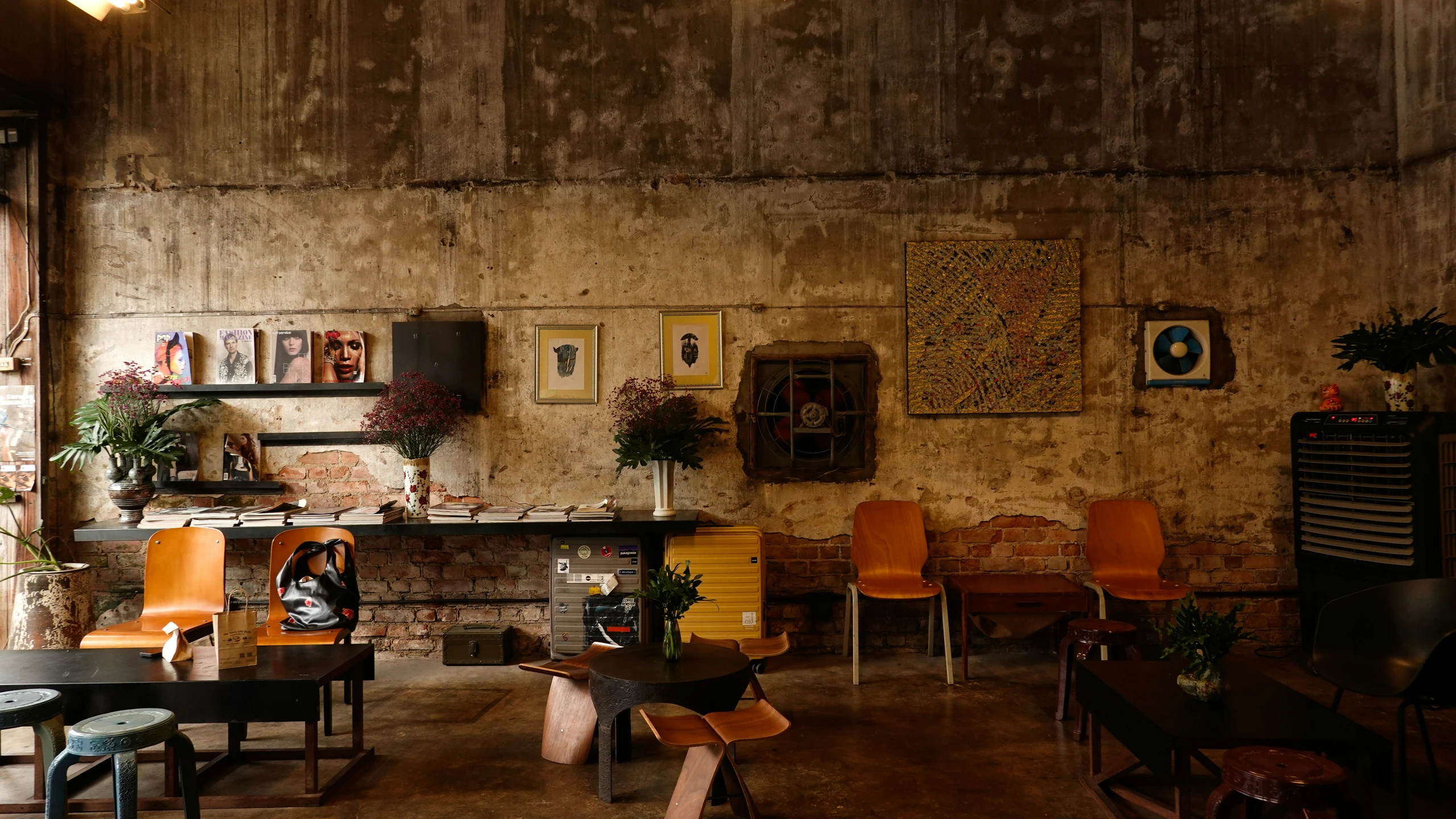
What connects co-living and co-working lies less in the uses they bring together than in the time people give them.
That familiarity changes the place of music: it is no longer simply heard; it becomes part of life over time. We let the musical presence evolve with the life of the place without loosening its identity. Co-living remains shaped by living there; co-working by working there. We govern what connects them from that distinction.
Space
Co-living
Over time, co-living gathers everything that makes up a daily life: routines taking root, familiar faces, shared moments finding their own rhythm, and the essential freedom to join communal life or return to one's own.
Music therefore enters into a very different relationship with time from the one it has in a place people merely pass through. What feels right on first hearing must still feel right days, weeks and sometimes months later; what sits naturally within a shared moment cannot assume the same presence when the place becomes more private again. At this scale, repetition matters as much as selection itself, and renewal is no longer a matter of replacing tracks at regular intervals. It is about preserving enough discovery to keep familiarity from turning into predictability.
Music Eye View governs that duration as much as the music within it. We shape the repertoire, its density, the place of voices, transitions and silence so that the character of the place can shift without losing what makes it recognisable. Some hours can carry more musical presence; others are better served by restraint. The point is never to fill daily life with music, but to leave enough room for a sound direction to belong there without taking it over.
Co-working
What begins in concentration can open into conversation, extend over a meal, make room for movement, then gradually take on a more social tone. Yet the whole place never turns at once: as one part of the day loosens, another still needs the calm, clarity and quality of attention without which work becomes harder.
That gives music a question of its own. It cannot simply follow the clock, because several versions of the place may exist at the same time; nor can it settle into a safe middle presence that never quite suits any of them. Its judgement lies instead in accompanying what opens up without intruding on what remains focused, in gaining presence without losing proportion, and in leaving certain breaths of quiet untouched when work still needs them.
Music Eye View governs this plurality without flattening it. The sound direction can grow in scale, change colour, become lighter or disappear altogether, but every shift remains connected to the same understanding of the place. Coherence comes not from making programmes resemble one another, but from the precision with which their differences have been intended.
Time
While one part of the place remains absorbed in work, another has already opened up to food, movement or conversation; later, social life gains ground while the demands of earlier hours still persist here and there.
Co-living and co-working are shaped by times that cross, extend into one another and sometimes pull in different directions, far more than by a neat sequence of clearly separated moments. The day does not move through fixed slots: it changes by degrees, through shifts, as one use slowly permeates another.
This is the moving geography of time that we read. Space, use and moment are never considered apart: where they meet determines the place music can take, the place it must give up, the contrasts it can carry and the continuities it must preserve. Time, in this sense, is no longer about moving from one programme to the next; it becomes the art of allowing several lives of the place to coexist without any of them losing its measure.
What endures
A sound identity is not sustained only by what is playing today. It also depends on what will make it possible tomorrow to understand why certain forms of presence were chosen, why others were set aside, what may evolve freely and what asks for greater continuity. In places where uses, teams and rhythms change, that memory becomes part of the governance itself.
A legible sound direction
It brings together the principles that give the place coherence without trapping the music in a formula. Registers, density, the use of voices, intensity, transitions and silence all belong to the same direction: precise enough to be recognised, open enough to remain alive.
Differences by design
Co-living and co-working do not call for the same forms of presence or the same balance at every moment. Coherence therefore does not mean forcing them closer together. It means knowing why certain differences should remain, how far they may go, and what continues to connect the whole in spite of them.
A memory of decisions
Over time, programmes are renewed faster than the reasons that shaped them. We preserve that memory: what led to a direction being chosen, what was set aside, what changed and what still deserves to be protected. A new team therefore inherits not only programmes, but the thinking that holds them together.
Rules that can evolve
The life of a place eventually shifts every balance: new uses appear, certain moments become more important, habits change. Governance allows those movements without rebuilding the identity each time something changes. It distinguishes what can move, what calls for a new decision, and what needs to remain stable enough for the place to keep recognising itself.
Continuity without stillness
Programmes, repertoires and intensity can change substantially without the identity coming apart. What endures is not a selection of tracks or a repeated musical colour, but a way of deciding, of relating differences, and of retaining through every change the memory of what gives the place its voice.
Settings
Some places are built around a new way of living; others rethink the place work can take; still others bring those two worlds closer together. It is precisely because their uses answer one another without becoming the same that the sound direction must be able to hold different balances together.
Co-living
Shared residences, apartments or studios where communal life extends well beyond the private space. Music enters into a long relationship with the people who live there: it must live comfortably with familiarity, repetition and renewal while leaving the possibility of withdrawal intact.
Co-working
Shared workspaces, flexible offices, independent locations or networks operating across several sites. The day may change register several times without work ever ceasing to provide its underlying structure. The sound direction follows those shifts while preserving what concentration, conversation and professional use continue to require.
Mixed settings
Some projects bring residence, work, food, wellbeing, events and social life close enough to blur boundaries that once seemed clear on paper. We do not flatten them into a single mood. We govern the differences that give them their richness, allowing each use to keep its own measure while still belonging to an identity the place can recognise as its own.
Frequently asked questions
Does every space need the same sound identity?
No. A shared identity does not require the same programmes or the same intensity everywhere. What matters is the coherence of the direction: some spaces may carry a stronger musical presence, others may call for greater restraint or even silence, without the place losing its continuity in sound.
How do you keep the music from becoming repetitive for residents or regular members?
Repeated exposure is built into the governance from the outset. We work with the depth of the repertoire, its renewal, variations in density and register, and the moments when music should withdraw. The aim is not change for its own sake, but to preserve a familiarity that never becomes predictable.
Can Music Eye View be involved before the place opens?
Yes. Music Eye View can work very early in the project, while uses, rhythms and the relationships between spaces are still being defined. This allows the sound direction to be considered before distribution choices or operating habits begin to constrain it, and then carried through implementation and into the life of the place.