Hospitality
The lobby welcomes guests; the restaurant, bar and spa each offer a different experience. Music Eye View creates background music for hotels and resorts that brings these experiences together, with a sound identity shaped by the brand and how each space is used.
Our curators build bespoke playlists around the time of day and the pace of service. We schedule, stream and continually develop the music, giving fine-dining restaurants, bars and spas their own musical character.
Background music for hotels and restaurants
Background music for hotels connects spaces that belong to the same property, yet are never heard in quite the same way.
Coherence therefore does not come from repeating a musical genre from room to room. It lies in the way choices are made: how voices, rhythm, density, familiarity, discovery and silence are balanced.
The same identity can then take very different forms without becoming unrecognisable.
Hotel lobby music
The lobby is many things at once. It is where a guest first discovers the property, waits, works for a few minutes, or simply passes through a space the team crosses all day. Its music cannot belong wholly to any one of those uses.
This is often where the sound identity is first encountered. Not as an emphatic signature, but as a way into the property: a density, a colour, a particular relationship between musical presence and human voices.
Restaurant and bar music
A restaurant can change profoundly over the course of a single day. Breakfast, lunch, dinner and then the bar do more than alter the timetable: conversation, service, density and dwell time repeatedly reset the balance of the same space.
Programming can become more prominent, lighter, more open or more concentrated without stacking one atmosphere on top of another. The point is to let one direction evolve until it finds the right balance for each service. Our restaurant music service translates this direction into custom music playlists.
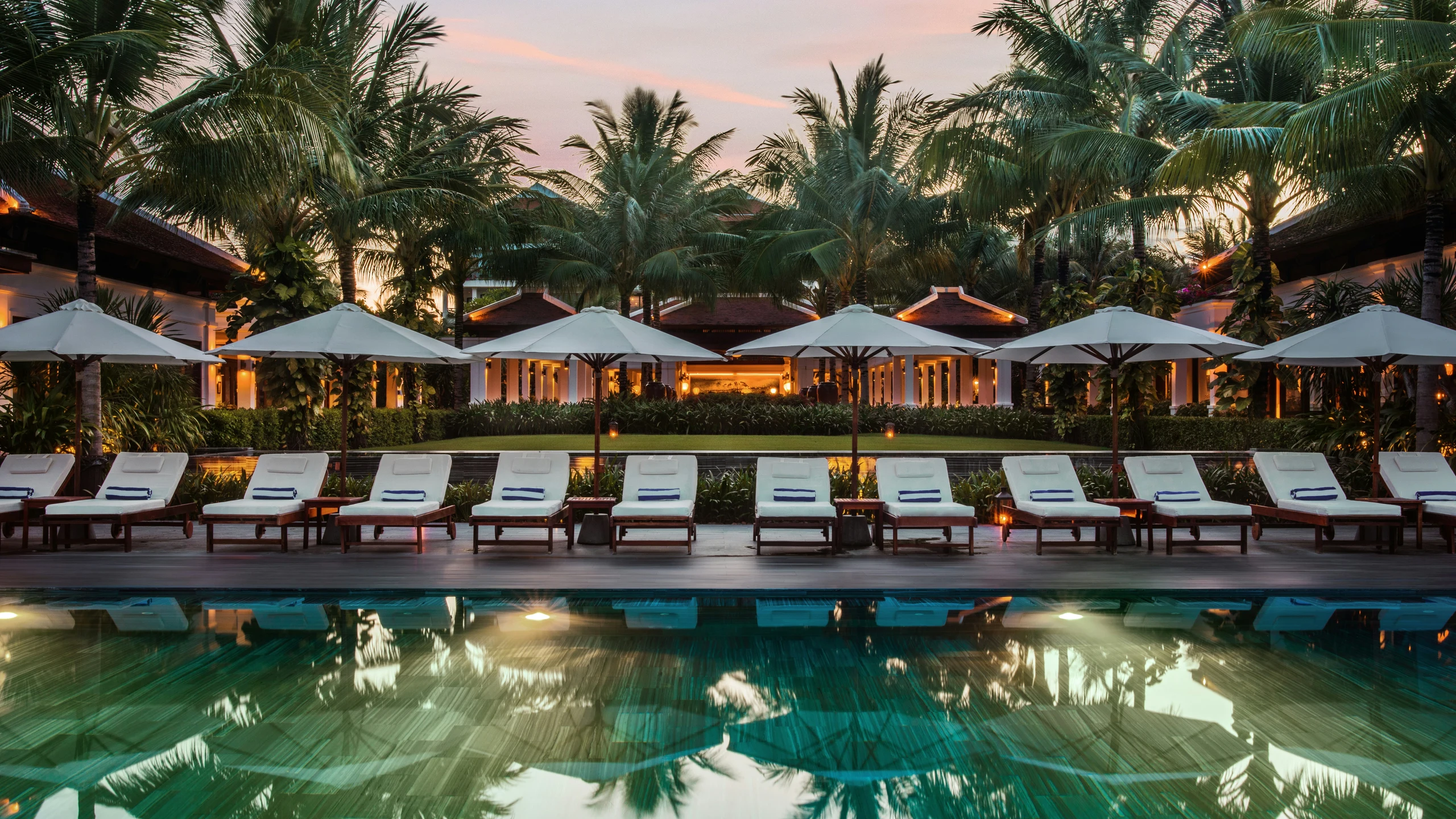
Music for pools and private beaches
Outdoors, music meets what it cannot control: water, wind, voices, distance and the soundscape of the place itself. What feels measured indoors can become intrusive a few metres away.
Background music for hotels therefore has to leave room for the life of outdoor spaces. It decides what deserves to be heard while preserving what should remain alive around it. Here, getting it right often depends as much on what is not covered as on what is added.
Hotel spa and gym music
A spa and a gym can belong to the same property while asking for almost opposite relationships with musical presence. In one, silence takes up more room, tracks sit further apart and voices and timbres become more exposed. In the other, movement allows greater density and a stronger pulse.
Continuity therefore does not have to come through tempo or intensity. It may lie in timbre, in the treatment of voices and textures, or in the balance between familiarity and discovery. Two very different musical worlds can still belong unmistakably to the same property.
Music for rooms and suites
Once the door closes, the guest regains control of the space. Nothing obliges them to listen. Music may accompany waking, returning to the room or a few minutes before going out again; it may also disappear entirely.
Silence is then neither a gap nor a break in the identity. It is one of the available choices. Background music for hotels must remain recognisable even when it gives way to silence.
Circulation and thresholds
A corridor, lift, walkway or garden is not a destination. It connects spaces whose balances may be very different.
Background music for hotels can also connect spaces, preparing what comes next rather than forming a programme in its own right. A transition, a change in density or a shift in timbre can prepare what comes next or let what has just ended fall away. It is often in these few seconds that continuity between different expressions becomes perceptible.
The rhythms of hospitality
Background music for hotels follows places that can change character several times in the same day without changing a thing about their setting.
Morning begins quietly. Arrivals gather, lunch and dinner alter the pace, then the bar may carry the property into another register. The spaces remain the same; the balance between movement, conversation, attention and music does not.
Those shifts rarely happen exactly when the schedule says they should. A lobby can empty almost at once; a restaurant can fall quiet between services; a bar may take longer to gather pace. In those intervals, music becomes more exposed. A voice can feel too close, a track too dense, a transition too abrupt.
Then the balance changes again. Guests return, conversations build, teams move faster, a terrace fills. Music can take more space with that movement, then recede as the property settles, without chasing every fluctuation or forcing the next moment to arrive.
The clock remains a reference, never the whole answer. At three in the afternoon, the same lobby may hold someone arriving, someone waiting, someone working for a few minutes and a member of staff crossing it for the tenth time that day. They share an hour, not the same experience of the place.
Sound direction begins with that distinction.
Hotel background music service: programmes and governance
Background music for hotels has to evolve with the place. Seasons return, opening hours shift, new teams take over, programmes are renewed and some habits become so familiar that their origins disappear.
For a sound identity to keep evolving without starting again from zero, the property needs to retain more than the programmes it plays. It must be able to recover the choices, reference points and reasons that connect them.
Planning music for each hotel space
The property is documented through what actually shapes the listening experience: spaces, hours, patterns of use, flows, peaks of activity and times when the music needs to recede.
What remains useful is not simply a description of the place, but the logic that follows from it: why music can take more space here, needs to recede there, and why neighbouring areas may call for very different responses.
Hotel music programming by space and time
Our hotel music programming gives the lobby, restaurant, bar and spa their own programmes and schedules. We select the music for each space and time of day, keeping a shared sound identity across the property.
Repertoire will evolve. Programmes may be refreshed or reassigned. What remains is the relationship that allows those different forms to continue belonging to the same identity.
Music guidance for hotel teams
Operating background music for hotels requires room for judgement. A terrace fills earlier, dinner runs on, the bar changes pace, a new team takes over.
The guide helps hotel teams choose the appropriate music programme and understand which playback adjustments they can make locally. It also identifies when a change needs to be discussed with Music Eye View so that day-to-day decisions stay connected to the property’s sound identity.
What the place becomes
A property does not change only when it is redesigned. It changes as the life within it settles into its own patterns: a terrace acquires a role no plan had assigned it, the lobby holds guests who were meant simply to pass through, the bar carries the day beyond the hour imagined for it. Gradually, these shifts alter the hierarchy of spaces and the way the whole place breathes. Sound direction has to recognise what belongs to a passing moment and what everyday life has made part of the place.
Governance documentation
With time, reasons fade faster than decisions. A new team may know that a programme changed without knowing what made the change necessary.
The documentation preserves that memory: significant decisions, changes, judgements and reference points that allow the identity to be picked up where it is, rather than mechanically reproducing what came before.
Hotels, resorts and private residences
Some hotels stand alone. Others belong to groups or portfolios that stretch across countries and continents. Residences, villas and private clubs can cultivate a sense of intimacy that feels almost familial.
The same question changes scale in each case: what must remain recognisable when places, uses and guests differ?
Music for boutique and independent hotels
In independent properties, background music for hotels can sit very close to the character of the place itself. It takes account of the architecture, rhythm of service, guests and sometimes habits that have been there for years.
There is no need to start again. The work is also to recognise what already belongs to the property and distinguish what is still genuinely chosen from what has simply settled in over time.
Groups, resorts and portfolios
As a collection grows, background music for hotels needs a shared musical direction that connects properties without giving them all the same programmes.
Our work with LUX* began at Grand Baie, a luxury lifestyle hotel, and has grown to encompass six properties in Mauritius across LUX*, SALT and Tamassa. Since 2020, we have also worked with 369°’s hotels, from the Alps to St Barthélemy.
Each property has its own musical character within a coherent whole.
Residences, villas and private clubs
In these places, the line between hospitality and intimacy becomes finer. Guests may spend longer, return more often and look less for the spectacle of a hotel and more for the familiarity of a place they already know.
The sound direction can therefore become more discreet. It accompanies without occupying, suggests more than it asserts and leaves more room for silence.
Background music for hotels can keep a place recognisable without making it sound the same everywhere.
Frequently asked questions
We already have a sound system and equipment in place. Does everything need replacing?
No. Music Eye View starts with what is already in place. If the playback system, equipment and network can carry the sound direction properly, there is no reason to replace them.
The programmes are then integrated into the existing setup in coordination with the technical teams. A change is recommended only when equipment or configuration genuinely prevents the agreed direction from being delivered properly.
Technology does not need to come before the music. It simply needs to carry it.
How much freedom will my teams have over the music?
The life of a property never fits exactly what was planned. An evening runs on, a terrace changes pace, a bar fills faster than expected. The teams are often the first to notice those shifts.
That freedom is real, but it is defined in advance through governance. Depending on the space, several programmes may be available and some adjustments can remain local; other situations call for a return to the shared direction.
The aim is to let the property move without losing what makes it recognisable.
We have several properties. Do we need to start everywhere at once?
Not necessarily.
One property can be enough to distinguish what genuinely belongs to the brand from what belongs to the place itself. It helps identify which choices can travel, which need to adapt and which only make sense at that property.
The properties that follow do not receive a copy. They take up a shared direction and find their own way of making it heard.